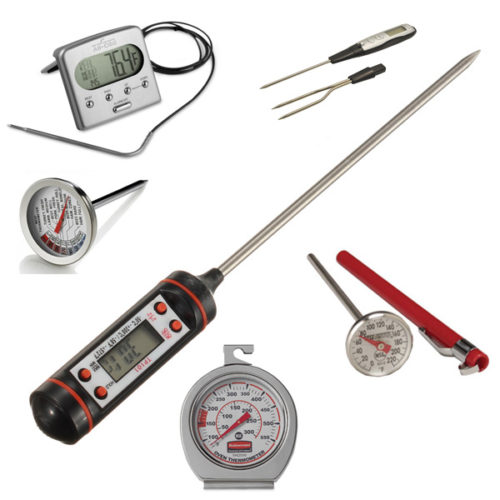
Types of food thermometers for cooking -are essential to any Chef or Cook both in their restaurant and home kitchen. I always have one on hand when grilling, baking, sauteing or really any type of cooking. Not only does a thermometer help to keep your meats juicy and cooked to the ideal temp, it also takes the guess work out of keeping your food safe!
Using the Food Thermometer – Most available food thermometers will give an accurate reading within 2 to 4 °F. The reading will only be correct, however, if the thermometer is placed in the proper location in the food. If not inserted correctly, or if the food thermometer is placed in the wrong area, the reading will not accurately reflect the internal temperature of the food. In general, the food thermometer should be placed in the thickest part of the food, away from bone, fat, or gristle.
Types of Food Thermometers for Cooking

Dial Instant-Read (MY GO TO)
- Provides an instant read on internal meat temperatures from 0- to 220-degrees Fahrenheit
- Usually stainless steel construction is light, tough and shock-resistant
- Comes with a sleeve to use as a holder
- Reads in 15-20 seconds
- Can be used in roasts, casseroles, and soups, steaks, chicken etc.
- Make sure it can be calibrated; check manufacturer’s instructions
- Available in most stores
 Thermometer-Fork Combination
- Reads in 2-10 seconds
- Place at least “¼” deep in thickest part of food
-
Lights will tell if the food has reached rare, medium, well done, etc.
- Used even in the thinnest foods
-
Combines a cooking fork with a food thermometer.
- Useful when grilling
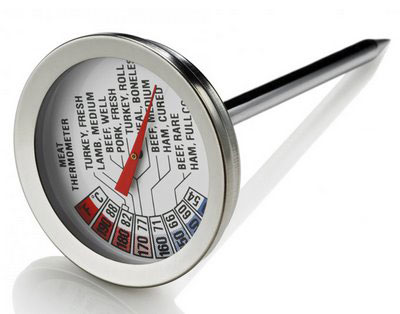 Dial Oven-Safe (Bimetallic-coil Thermometers)
-
Designed to remain in the food while it is cooking in the oven
-
Can take as long as 1 to 2 minutes to register the correct temperature
-
Accurately measures the temperature of relatively thick foods
- Can be used in roasts, casseroles, and soups, (foods in stockpot)
-
The temperature should be taken in a second, and even third area, to verify the temperature of the food
- Some models can be calibrated; check manufacturer’s instructions
Types of Food Thermometers for Cooking
 Deep Fry/Candy Thermometer
- Measure extra-high temperatures when Deep frying
- Measure extra-high temperatures for candy and jelly making
- Temperature range 100 to 400 Degree F
- Designed for specific temperature ranges
 Digital Instant-Read
- Reads in roughly 10 seconds
-
Can measure temperature in thin foods, as well as thick foods
-
Place the tip in the center of the thickest part of the food
- Not designed to remain in food while cooking (not oven safe)
-
Should be used near the end of the estimated cooking time
- Get one that can be calibrated; check manufacturer’s instructions
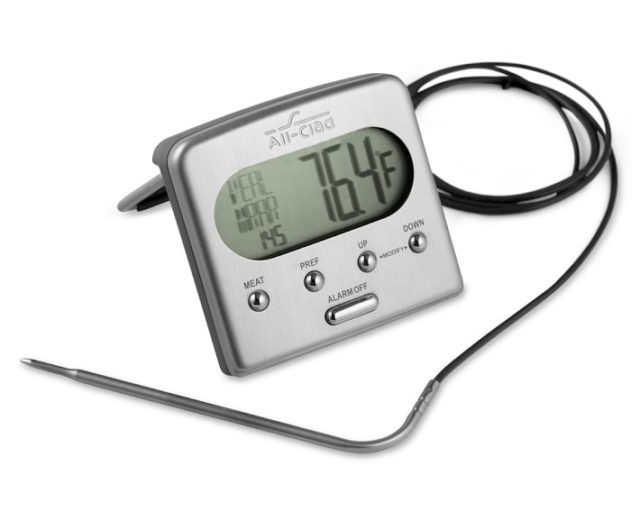 Oven Probe / Thermistor Thermometer
 Pop-Up Thermometer
- Reliable to within 1 to 2°F, however proper placement is important
- Pops up when food reaches safe final temperature or doneness
- Checking with conventional food thermometer is always recommended
- Mostly used in turkeys and roasting chickens since 1965
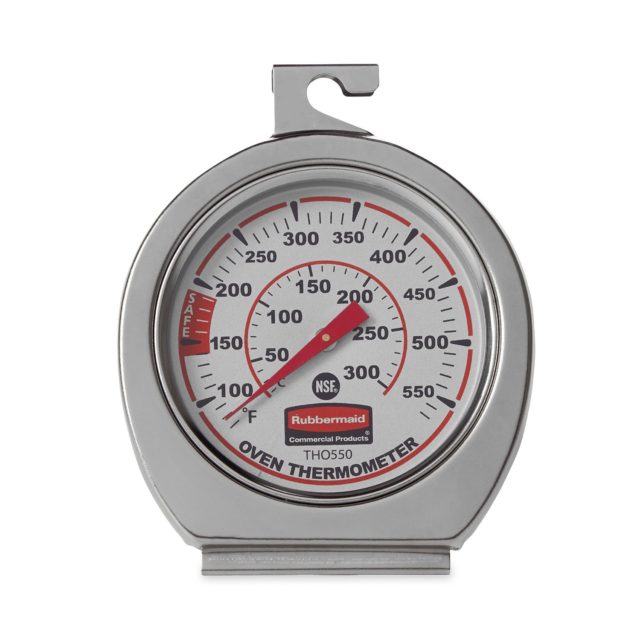 Oven Thermometer
Types of Food Thermometers for Cooking
Check Manufacturer’s Instructions – Before using a food thermometer, read the manufacturer’s instructions first. The instructions should tell how far the thermometer must be inserted in a food to give an accurate reading. If instructions are not available, check the stem of the food thermometer for an indentation, or “dimple.” This shows one end of the location of the sensing device. Dial thermometers must penetrate about 2 to 3 inches into the food. Most digital thermometers will read the temperature in a small area of the tip.
Types of Food Thermometers for Cooking
Where to Place the Food Thermometer
Meat
When taking the temperature of beef, pork, or lamb roasts, the food thermometer should be placed midway in the roast, avoiding the bone. When cooking hamburgers, steaks, or chops, insert a thermistor or thermocouple in the thickest part, away from bone, fat, or gristle. If using a dial bimetal thermometer, read “Thin Foods” below. When the food being cooked is irregularly shaped, such as with a beef roast, check the temperature in several places.
Poultry
FSIS recommends cooking whole poultry to a safe minimum internal temperature of 165 °F as measured with a food thermometer. Check the internal temperature in the innermost part of the thigh and wing and the thickest part of the breast. For reasons of personal preference, consumers may choose to cook poultry to higher temperatures. For optimum safety, do not stuff poultry. If stuffing whole poultry, the center of the stuffing must reach a safe minimum internal temperature of 165 °F. If cooking poultry parts, insert food thermometer into the thickest area, avoiding the bone. The food thermometer may be inserted sideways if necessary. When the food is irregularly shaped, the temperature should be checked in several places.
Thin Foods
When measuring the temperature of a thin food, such as a hamburger patty, pork chop, or chicken breast, a thermistor or thermocouple food thermometer should be used, if possible. However, if using an “instant-read” dial bimetallic-coil food thermometer, the probe must be inserted in the side of the food so the entire sensing area (usually 2-3 inches) is positioned through the center of the food.
To avoid burning fingers, it may be helpful to remove the food from the heat source (if cooking on a grill or in a frying pan) and insert the food thermometer sideways after placing the item on a clean spatula or plate.
Combination Dishes
For casseroles and other combination dishes, place the food thermometer into the thickest portion of the food or the center of the dish. Egg dishes and dishes containing ground meat and poultry should be checked in several places.
Types of Food Thermometers for Cooking
Thermometer Care
As with any cooking utensil, food thermometers should be washed with hot soapy water. Most thermometers should not be immersed in water. Wash carefully by hand. Use caution when using a food thermometer. Some models have plastic faces, which can melt if placed too close to heat or dropped in hot liquid. Thermometer probes are sharp and should be stored with the probe in the stem sheath. Some glass thermometers are sensitive to rough handling and should be stored in their packaging for extra protection or in a location where they will not be jostled.
Calibrating a Thermometer
There are two ways to check the accuracy of a food thermometer. One method uses ice water, the other uses boiling water. Many food thermometers have a calibration nut under the dial that can be adjusted. Check the package for instructions.
Ice Water
To use the ice water method, fill a large glass with finely crushed ice. Add clean tap water to the top of the ice and stir well. Immerse the food thermometer stem a minimum of 2 inches into the mixture, touching neither the sides nor the bottom of the glass. Wait a minimum of 30 seconds before adjusting. (For ease in handling, the stem of the food
thermometer can be placed through the clip section of the stem sheath and, holding the sheath horizontally, lowered into the water.) Without removing the stem from the ice, hold the adjusting nut under the head of the thermometer with a suitable tool and turn the head so the pointer reads 32 °F.
Types of Food Thermometers for Cooking
Boiling Water
To use the boiling water method, bring a pot of clean tap water to a full rolling boil. Immerse the stem of a food thermometer in boiling water a minimum of 2 inches and wait at least 30 seconds. (For ease in handling, the stem of the food thermometer can be placed through the clip section of the stem sheath and, holding the sheath horizontally, lowered into the boiling water.) Without removing the stem from the pan, hold the adjusting nut under the head of the food thermometer with a suitable tool and turn the head so the thermometer reads 212 °F. For true accuracy, distilled water must be used and the atmospheric pressure must be one atmosphere (29.921 inches of mercury). A consumer using tap water in unknown atmospheric conditions would probably not measure water boiling at 212 °F. Most likely it would boil at least 2 °F, and perhaps as much as 5 °F, lower. Remember that water boils at a lower temperature in a high altitude area. Check with the local Cooperative Extension Service or Health Department for the exact temperature of boiling water.
Even if the food thermometer cannot be calibrated, it should still be checked for accuracy using either method. Any inaccuracies can be taken into consideration when using the food thermometer, or the food thermometer can be replaced. For example, water boils at 212 °F. If the food thermometer reads 214 °F in boiling water, it is reading 2 degrees too high. Therefore 2 degrees must be subtracted from the temperature displayed when taking a reading in food to find out the true temperature. In another example, for safety, ground beef patties must reach 160 °F. If the thermometer is reading 2 degrees too high, 2 degrees would be added to the desired temperature, meaning hamburger patties must be cooked to 162 °F.
Types of Food Thermometers for Cooking
Here is a MEAT, POULTRY & PORK TEMPERATURE GUIDE
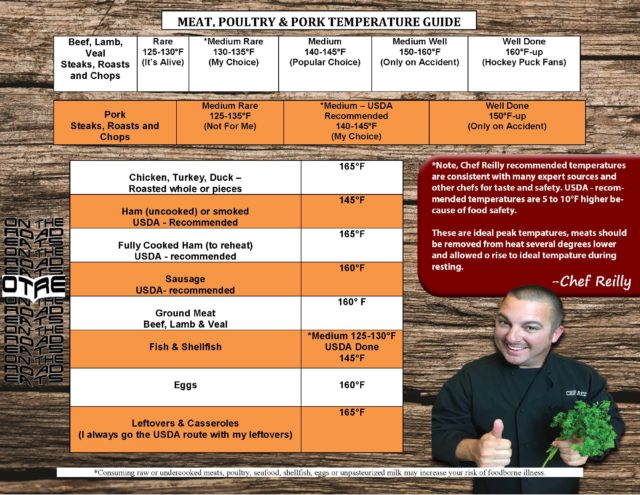
Meat and Poultry Temperature Guide – Download
Types of Food Thermometers for Cooking
Find more Kitchen Tools Every Cook Must Have here
OTREproductions.com
On The Road Eats, LLC
On The Road Eats & The F.A.S.T. Review with Chef Greg Reilly
You won’t find a better authority on food than a Chef! Chef Greg Reilly has put together On The Road Eats, a one stop for all your culinary interests.
Finger Lickin’ Good Recipes…Easy, Original, Family and from other Chefs. Recipes that you can cook at home and are super easy with easy how to instructions and video. Cooking Shows…from Chef Reilly’s own kitchen to restaurants and homes all over the world. The F.A.S.T. Review With all the choices out there, Chef Reilly will help you find places that will make your dining experiences unforgettable!
See Ya On The Road – Chef Greg Reilly
Types of Food Thermometers for Cooking
Save
Save


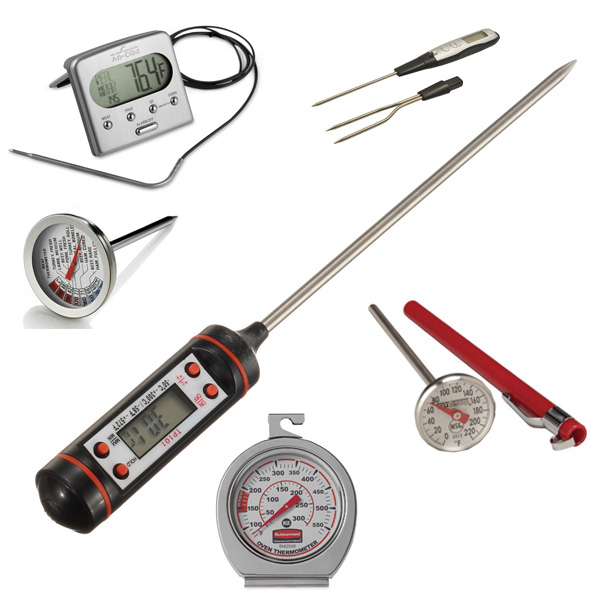
 Digital Instant-Read
 Pop-Up Thermometer