
Meat Poultry Pork Leftovers Temperature Guide
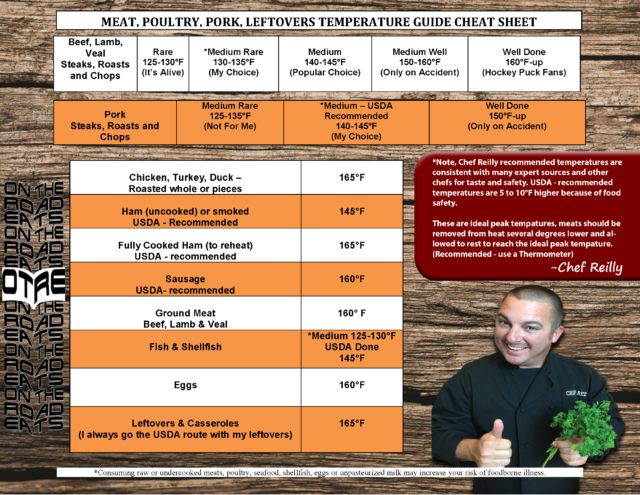
– Here is a Cheat Sheet you can use when cooking meat, poultry, pork and leftovers…my recommendations and USDA minimum!
Coming from a Chef it takes practice and time to get your cooking time for meats down, but even then we all should use a Thermometer to temp our meats. You can purchase different variations from oven safe to Dial Instant. I would recommend going out and getting a Dial Instant-Read. Easy to use, easy to calibrate and won’t break the bank. I have a few of them all over my kitchen.
Meat Poultry Pork Leftovers Temperature Guide
Why a Thermometer is Important, Here is a guide to the different types of Food Thermometers (see what types of thermometers here)
Remember, you can’t always tell whether meat, poultry, pork or fish is safely cooked by looking at it. Any cooked, uncured red meats – including pork – can be pink, even when the meat has reached a safe internal temperature.
As a Chef and I am sure everyone, always want their Meat, Poultry, and Pork to be tender, juicy and full of flavor, but I also they want it safe! The internal temperature of meat controls all of these things and understanding what temp is optimum and safe is at the core of good cooking.
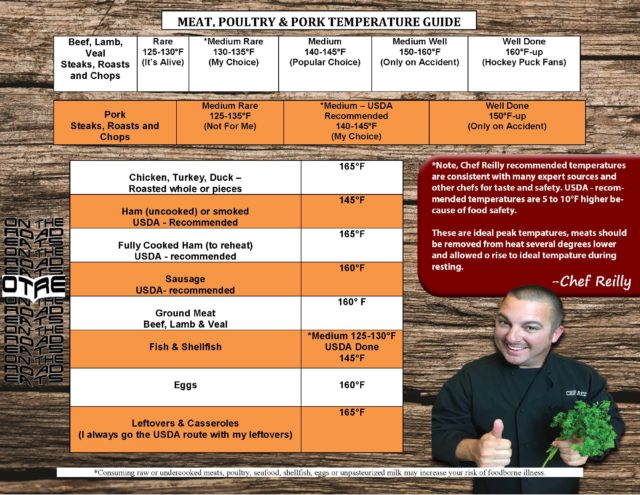
Use this chart and a food thermometer to ensure that meat, poultry, seafood, and other cooked foods reach a safe minimum internal temperature.
The interior of a cut of meat will still increase in temperature 5–10 °F after it is removed from an oven or other heat source. The meat should be allowed to “rest” for a suitable amount of time (depending on the size of the cut or steak) before being served, which makes the meat easier to carve and its structure firmer and more resistant to deformation; its water-holding capacity also increases and less liquid is lost from the meat during carving.
During the rest time, its temperature remains constant or continues to rise, which destroys harmful germs.
The temperatures indicated above are the peak temperature in the cooking process, so the meat should be removed from the heat source a few degrees cooler.
Why you need a few different kinds of cutting boards (see the cutting board chart here)
Food born illness is a real and occurring hazard in all our kitchens daily. I always have 3 to 4 boards specifically for cutting raw meats, poultry and fish and seafood. We all know some Chicken are contaminated with Salmonella, you don’t want to mix that with your veggie salad, or anything else your cutting raw. (or it could be a fun day in the bathroom or worse).
Always have 1 cutting board for the Meat, Poultry, Pork and Seafood and a SEPARATE cutting board for the Cooked Meat, Poultry, Pork and Seafood!
Check out the Meat Poultry Pork Leftovers Temperature Guide
Meat and Poultry Temperature Guide – Download
You can also find the USDA Safe Minimum Internal Temperature Chart Here
Find more Kitchen Tools Every Cook Must Have here
On The Road Eats & The F.A.S.T. Review with Chef Greg Reilly
See Ya On The Road – Chef Greg Reilly
Poultry temperature guide
Meat Poultry Pork Leftovers Temperature Guide